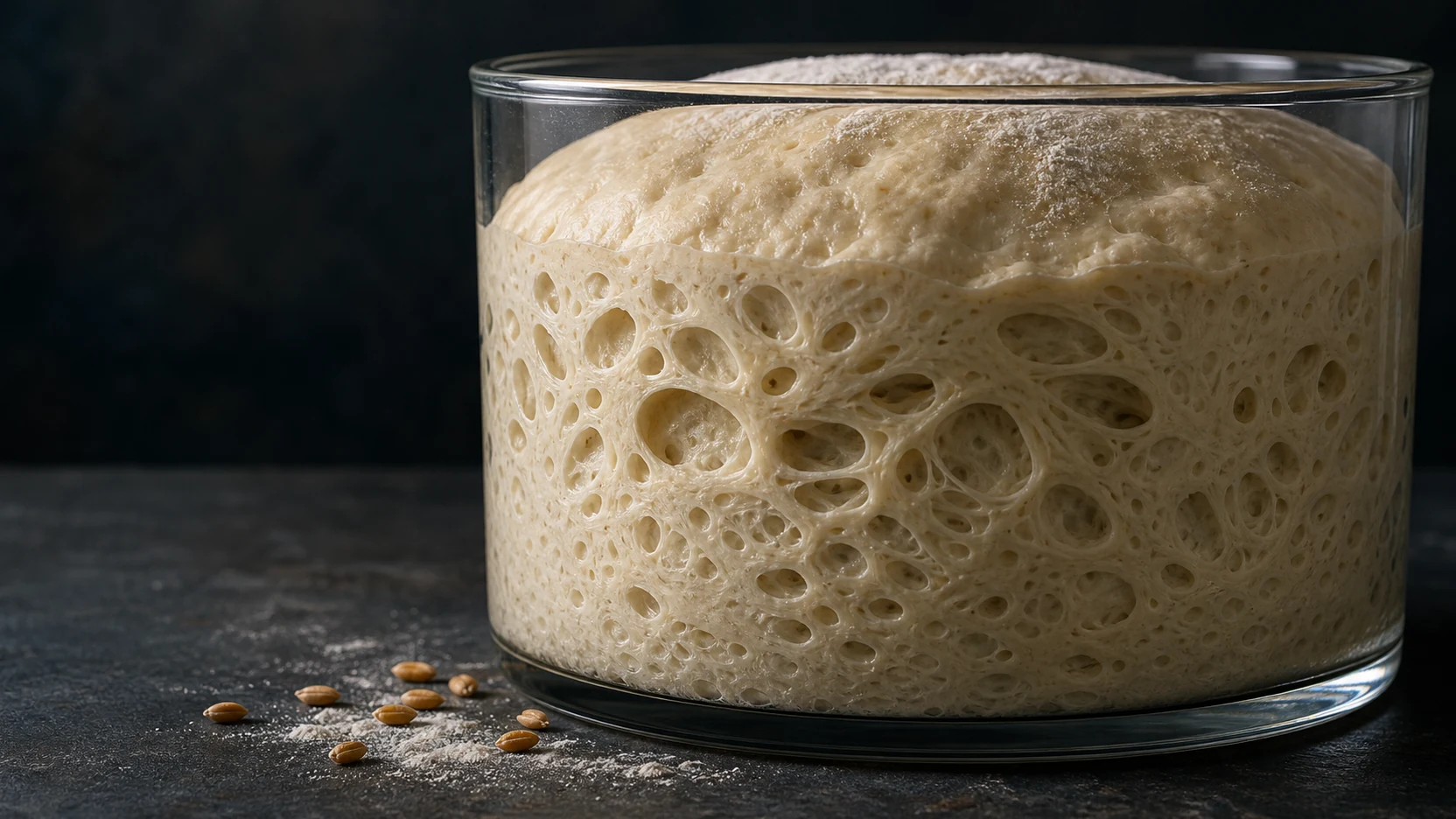
Quick Answer:Bread rises because yeast ferments sugars in the dough, producing carbon dioxide gas that gets trapped in an elastic network of gluten proteins. The gas inflates the dough like thousands of tiny balloons; heat during baking expands the gas further and sets the structure in place.
Yeast fermentation: the engine of the rise
Bread dough rises through a biological process: fermentation. Yeast — a single-celled fungus — consumes sugars in the flour and produces carbon dioxide and ethanol as waste products. The carbon dioxide forms bubbles inside the dough, and because the dough's gluten network stretches rather than tears, the bubbles expand and the dough inflates.
TheRoyal Society of ChemistryandCompound Interestboth illustrate the chemistry: enzymes in the flour (amylases) break starch into sugars the yeast can eat, and the yeast's fermentation produces the gas that does the lifting. Some gas also forms before yeast gets involved — commercial bread often includes chemical leaveners too.
The gluten network: the structure that traps the gas
Carbon dioxide alone would escape from a shapeless paste. What holds it in is gluten, the protein network that forms when wheat flour is mixed with water. Kneading aligns and strengthens these proteins into an elastic web. As fermentation produces gas, the web stretches around the growing bubbles; as the dough proofs, the web slowly relaxes and the bubbles grow larger.
Flour choice matters here: high-protein ("strong") flours produce more gluten and a taller, chewier loaf, while low-protein flours yield a softer, denser crumb. TheModernist Cuisine bread-making guideexplains how each stage — mixing, kneading, fermentation, proofing — builds and manages this network.
Enzymes and sugar: fueling the fermentation
Yeast does not eat raw starch. The dough's enzymes do the preparation: amylases break starch down into maltose and glucose, which yeast ferments readily. This is why dough benefits from a rest — the enzymes need time to produce fermentable sugars. It is also why very sweet doughs can rise slowly: high sugar concentrations draw water away from the yeast through osmosis, slowing fermentation.
Temperature and kneading: tuning the rise
Two variables control how fast the rise happens:
- Kneading.Working the dough develops the gluten network — more structure, better gas retention. Under-kneaded dough rises weakly; over-kneaded dough becomes tight and hard to stretch.
- Temperature.Yeast activity roughly doubles with every 10°C (18°F) increase within its working range. Warm dough ferments quickly; cold dough ferments slowly — which is why refrigerated ("cold proof") doughs develop deeper flavor over hours or days.
TheExploratorium's bread science pagecovers the practical side of these effects, and theRSC experiment pageshows how temperature changes the rate of gas production.
Chemical leavening: the no-yeast alternative
Not all bread rises with yeast. Baking powder and baking soda release carbon dioxide through acid–base reactions instead: baking soda (sodium bicarbonate) reacts with an acid in the batter, and baking powder contains both the base and the acid, releasing gas when wet and again when heated. These reactions are fast and one-way, which is why quick breads are mixed gently and baked immediately — there is no yeast to keep producing gas.
The bottom line
Bread rising is a partnership: yeast produces carbon dioxide, gluten traps it, and heat sets the result. The craft of breadmaking — choosing flour, kneading, controlling temperature and time — is really the craft of managing those three mechanisms so the dough inflates evenly and holds its shape.
Sources & further reading
- Royal Society of Chemistry
- Compound Interest
- Modernist Cuisine bread-making guide
- Exploratorium's bread science page
That’s the mechanism. The wonder is still allowed.