
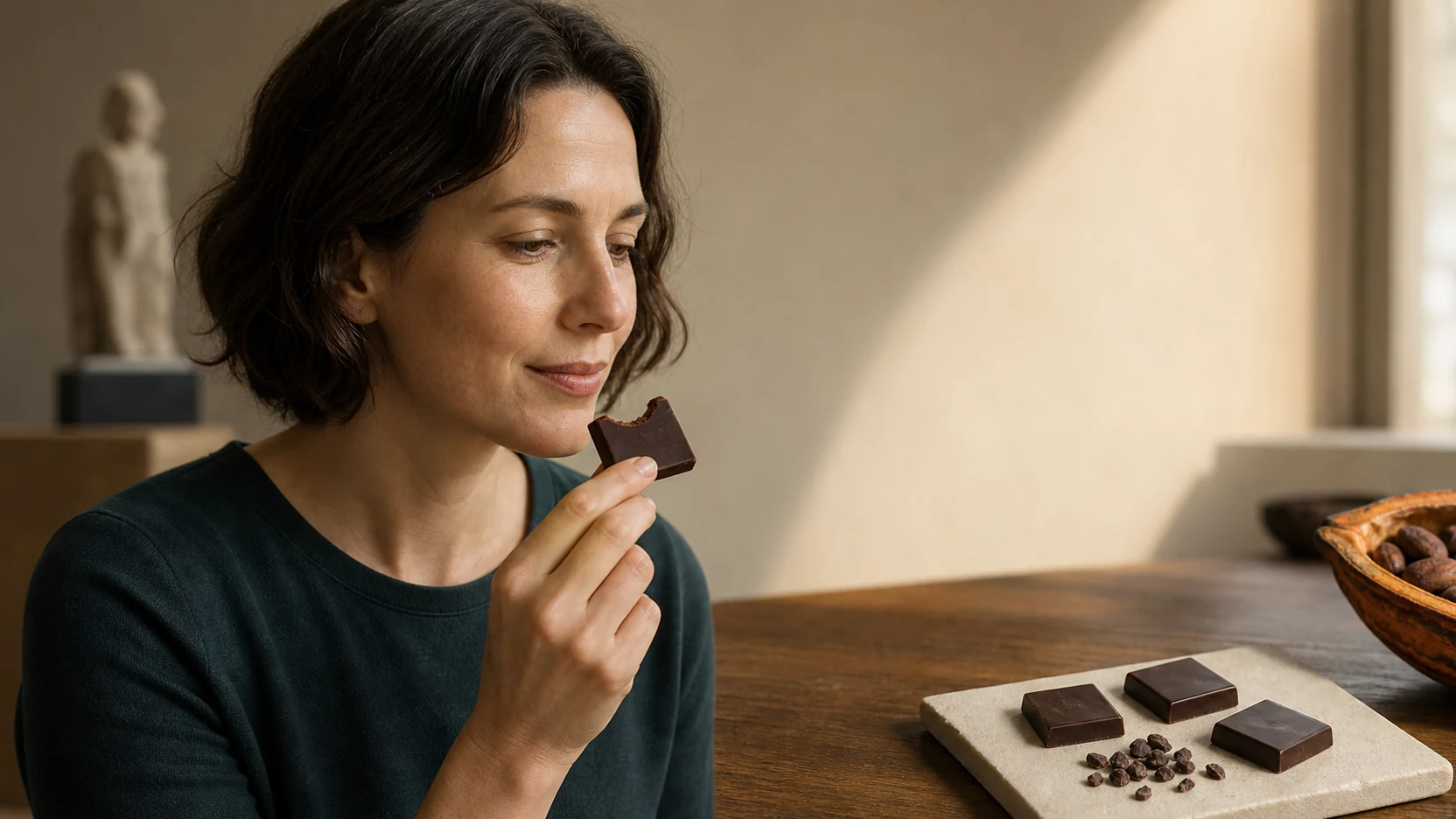
Quick Answer:Chocolate can brighten mood — but the honest version of the answer is modest. Chocolate contains compounds that interact with brain chemistry (including anandamide, phenylethylamine, and small amounts of caffeine and theobromine), it tastes and smells pleasant, and eating it is often wrapped in enjoyable rituals. Studies show small, short-lived mood effects, especially for dark chocolate; it is not a treatment for depression or persistent low mood.
The chemistry of happiness
Chocolate is a cocktail of biologically active compounds. The most discussed:
- Anandamide— a cannabinoid-like molecule sometimes called the "bliss molecule" because it acts on the same brain receptors as THC. Chocolate does contain it, but in tiny amounts, and it breaks down quickly in the body — far too fast to produce a cannabis-like effect from a bar of chocolate.
- Phenylethylamine (PEA)— a compound related to amphetamine that is sometimes called the "love chemical." It is present in chocolate, but it is also rapidly broken down by an enzyme in the gut (MAO-B) before much of it reaches the brain, so its direct contribution to mood is questionable.
- Tryptophan— an amino acid precursor to serotonin. Chocolate contains it, but many foods contain more, and dietary tryptophan does not reliably raise brain serotonin on its own.
- Caffeine and theobromine— mild stimulants that can increase alertness, contributing to the pleasant "lift" people notice.
TheAustralian Academy of Sciencegives a careful rundown of these compounds and why their effects are smaller than popular articles claim.
What studies actually find
Clinical research on chocolate and mood is mixed — and it pays to be precise about what the studies measured. A2013 systematic review inNutrition Reviewsevaluated the experiments available at the time: five of the eight mood studies found either an improvement in mood or a lessening of negative mood. But the reviewers cautioned that it's still unclear how much of the effect comes from chocolate's taste, texture, and the ritual of eating it rather than its chemistry — and the studies were small and brief.
One commonly cited experiment is atwo-week controlled study of 60 medical students. Those who ate 40 grams of dark or milk chocolate daily reported modestly lower perceived-stress scores afterward — about 2–3 points on a 40-point scale — while the comparison between the chocolate groups and the white-chocolate group was not statistically significant. Other experiments suggest the mood lift, when it appears, is brief: measured in minutes to an hour, and most clearly seen in people who were already feeling low.
The gut–brain connection
The most rigorous recent trial in this area tested the gut directly. In a2022 randomized controlled trial, 48 healthy young adults were assigned to eat 10 grams of 85% cocoa chocolate three times a day, 70% chocolate, or no chocolate, for three weeks. The 85% group reported a reduction in negative mood states, and those changes tracked with shifts in the mix of gut bacteria. The study was small, had no placebo chocolate, and couldn't fully rule out expectation — its authors called for larger trials. Still, the idea it tests is plausible: cocoa polyphenols feed certain gut bacteria, and bacterial by-products may influence the brain through the gut–brain axis.
Sensory pleasure and ritual
Part of chocolate's mood effect never involves chemistry reaching the brain. The flavor, aroma, and texture are genuinely pleasurable; eating it often happens in social or self-comforting moments; and expectation plays a role — people who believe chocolate will lift their mood tend to report that it does. These psychological factors are real effects, but they are the same effects any favorite food can have, which is why chocolate is not unique in its mood-boosting reputation.
Dark chocolate, moderation, and honest limits
Dark chocolate contains more cocoa — and therefore more flavanols — and less sugar than milk chocolate, which is why studies tend to use it. TheCleveland Clinic's review of dark chocolatesummarizes its nutritional case: it is a source of flavanols and minerals, but also calorie-dense, and its health effects are easily outweighed by overeating it.
The honest limits deserve emphasis: no study shows that chocolate treats depression, anxiety, or any mood disorder. For people with persistent low mood, professional support — not chocolate — is the appropriate response. For everyone else, the evidence supports a simple conclusion: an occasional piece of dark chocolate can be a genuinely pleasant, modest mood lift, and that is worth enjoying without dressing it up as medicine.
The bottom line
Chocolate's mood effects are real but small: a mix of trace bioactive compounds, sensory pleasure, ritual, and expectation, best documented for dark chocolate in the short term. Enjoy it as a treat — not as a therapy.
Sources & further reading
- Australian Academy of Science
- 2013 systematic review in Nutrition Reviews
- two-week controlled study of 60 medical students
- 2022 randomized controlled trial
- Cleveland Clinic's review of dark chocolate
That’s the mechanism. The wonder is still allowed.