

Instant Answer: The Root of Static Electricity
Static electricity occurs when electrons move from one material to another during contact, creating an imbalance of electric charge. This charge imbalance remains “static” (not flowing as current) until discharge occurs. The phenomenon is most common when insulating materials rub together, especially in dry conditions, resulting in effects like hair standing up, static cling, or those surprising shocks when touching doorknobs.

The Triboelectric Effect: A Closer Look
Have you ever wondered why rubbing a balloon on your hair makes it stick to the wall? That’s the triboelectric effect in action!
When two different materials come into contact and then separate, electrons transfer preferentially to one material, leaving a positive charge on the other. This electron exchange is the fundamental mechanism behind most static electricity we encounter daily.

How Charge Transfer Works
- Material contact: Two materials touch each other
- Charge exchange: Electrons move from one material to the other
- Separation: Materials separate, carrying their imbalanced charges
- Charge retention: Insulating materials hold onto their new charge state
Recent research from Northwestern University suggests that mechanical deformation of nanoscale surface features during rubbing generates voltages that drive charge separation. This explains why even identical materials can sometimes develop static charge and why surface roughness matters.
Interestingly, it’s not just electrons that can transfer. The American Scientist reports that ions and even charged molecular fragments may transfer during contact, adding complexity to what was once thought to be a simple phenomenon.
Factors Influencing Static Charge Accumulation
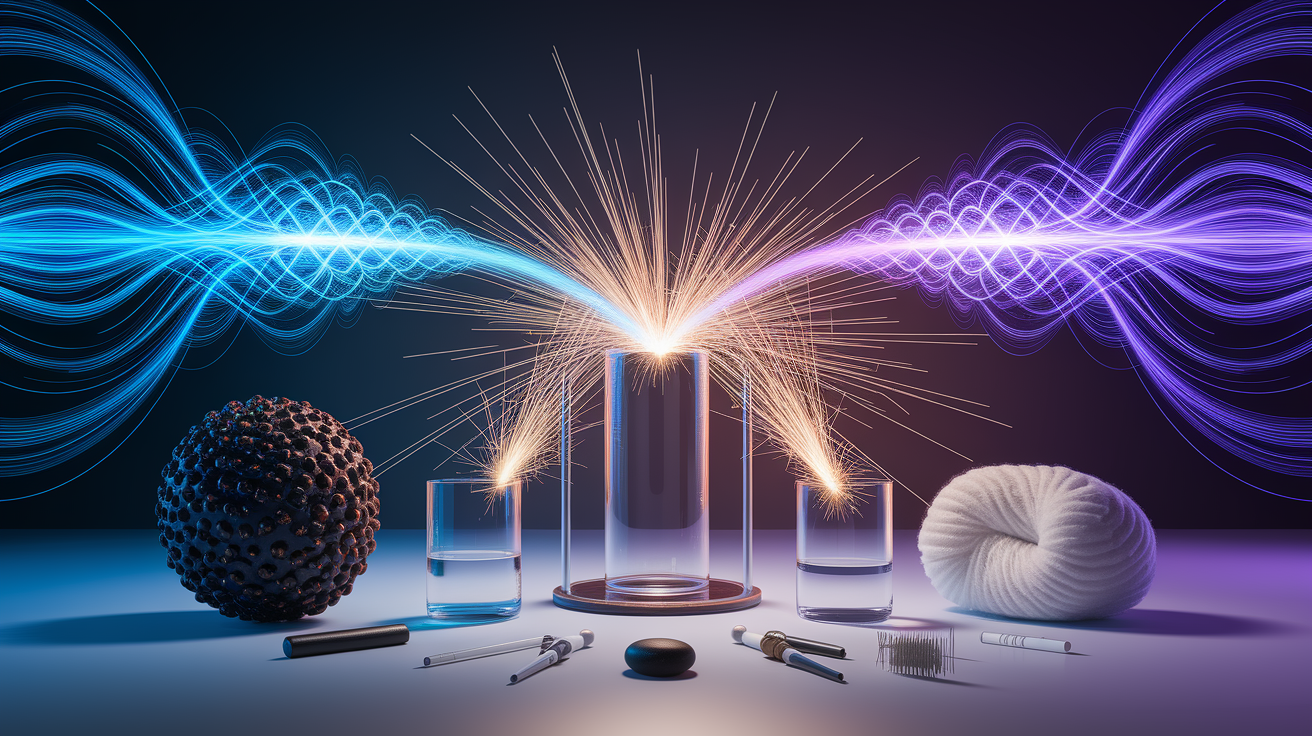
Not all materials or conditions create equal amounts of static electricity. Several factors determine how much charge builds up:
Material Properties
- Position in the triboelectric series: Materials have different tendencies to gain or lose electrons
- Surface chemistry: Contaminants, adsorbed water, or polymer composition affect charge transfer
- Conductivity: Insulators hold charge while conductors allow it to flow away
- Surface roughness: Rougher surfaces often create more contact points for charge exchange
Environmental Factors
- Humidity: Higher humidity reduces static buildup as moisture creates a conductive layer on surfaces
- Temperature: Cold, dry air favors static accumulation (explaining why static electricity is more common in winter)
- Air pressure: Can affect the ease of discharge
Contact Mechanics
- Contact area: Larger contact areas allow more charge transfer
- Friction intensity: More vigorous rubbing typically generates more static
- Duration of contact: Longer contact times may increase charge separation
- Repeated contact: Multiple contacts can build up larger charge imbalances
According to science education resources, synthetic fabrics like polyester and nylon are among the most notorious static generators, especially when rubbed against each other or natural materials like wool.
Electrostatic Discharge: The Spark of Static Electricity
That zap you feel when touching a doorknob after walking across carpet is an electrostatic discharge (ESD) – the sudden flow of electricity between objects with different electric potentials.
How Discharge Happens
When accumulated static charge finds a conductive path, it rapidly neutralizes. This can happen through:
- Direct contact with a conductor (like touching a doorknob)
- Breaking down the insulating properties of air (creating a visible spark)
- Gradual dissipation through slightly conductive materials
Potential Hazards of Static Electricity
While most static shocks are harmless if annoying, ESD can pose serious risks in certain situations:
- Electronics damage: Even small discharges can destroy sensitive electronic components
- Fire hazards: Sparks can ignite flammable vapors or dusts
- Manufacturing disruptions: Static can interfere with precision processes and attract contaminants
- Data loss: Discharge events can corrupt magnetic storage media
That’s why industries implement ESD control measures like grounding straps, conductive flooring, humidity control, and specialized packaging for sensitive components.
Everyday Examples and Measurements of Static Electricity
Common Static Electricity Experiences
- Hair standing up after removing a wool hat
- Clothes sticking together from the dryer
- Getting shocked after walking across carpet
- Paper bits attracted to a rubbed comb
- Balloons sticking to walls after being rubbed
- Lightning (nature’s most dramatic static discharge)
Measuring Static Electricity
Scientists measure static electricity using specialized instruments:

- Electrometers: Detect and measure small electric charges
- Electrostatic voltmeters: Measure electric potential without touching the charged object
- Faraday cups: Capture and measure total charge
Demonstrations and Experiments
The Van de Graaff generator is a classic device used to demonstrate static electricity principles. It uses mechanical work to accumulate large amounts of static charge, creating dramatic effects like making someone’s hair stand on end or generating impressive sparks.
Simple home experiments can also demonstrate static electricity:
- Rub a balloon on wool or hair, then watch it stick to walls
- Comb dry hair and observe how it attracts small paper bits
- Shuffle across carpet in socks, then touch a doorknob to feel a spark
- Rub a plastic ruler with wool and use it to pick up small pieces of paper
Conclusion: Harnessing the Power of Static Electricity
Static electricity is more than just an annoying shock or clingy clothing. Beyond its everyday manifestations, we’ve learned to harness this phenomenon in useful ways:
- Electrostatic precipitators clean pollutants from industrial emissions
- Photocopiers and laser printers use static charges to attract toner to paper
- Spray painting uses electrostatics to ensure even coating
- Emerging technologies like triboelectric nanogenerators convert mechanical energy to electricity
Understanding the science behind static electricity helps us manage its unwanted effects while putting its properties to good use. Next time you experience a static shock, you’ll know exactly what’s happening at the atomic level – electrons seeking balance in a world of charging materials.
To prevent unwanted static buildup, increase humidity in your home, use fabric softener for clothes, apply moisturizer to your skin and hair, and consider anti-static sprays for problematic surfaces. With these tips, you can keep static electricity under control while appreciating the fascinating physics behind this everyday phenomenon.