
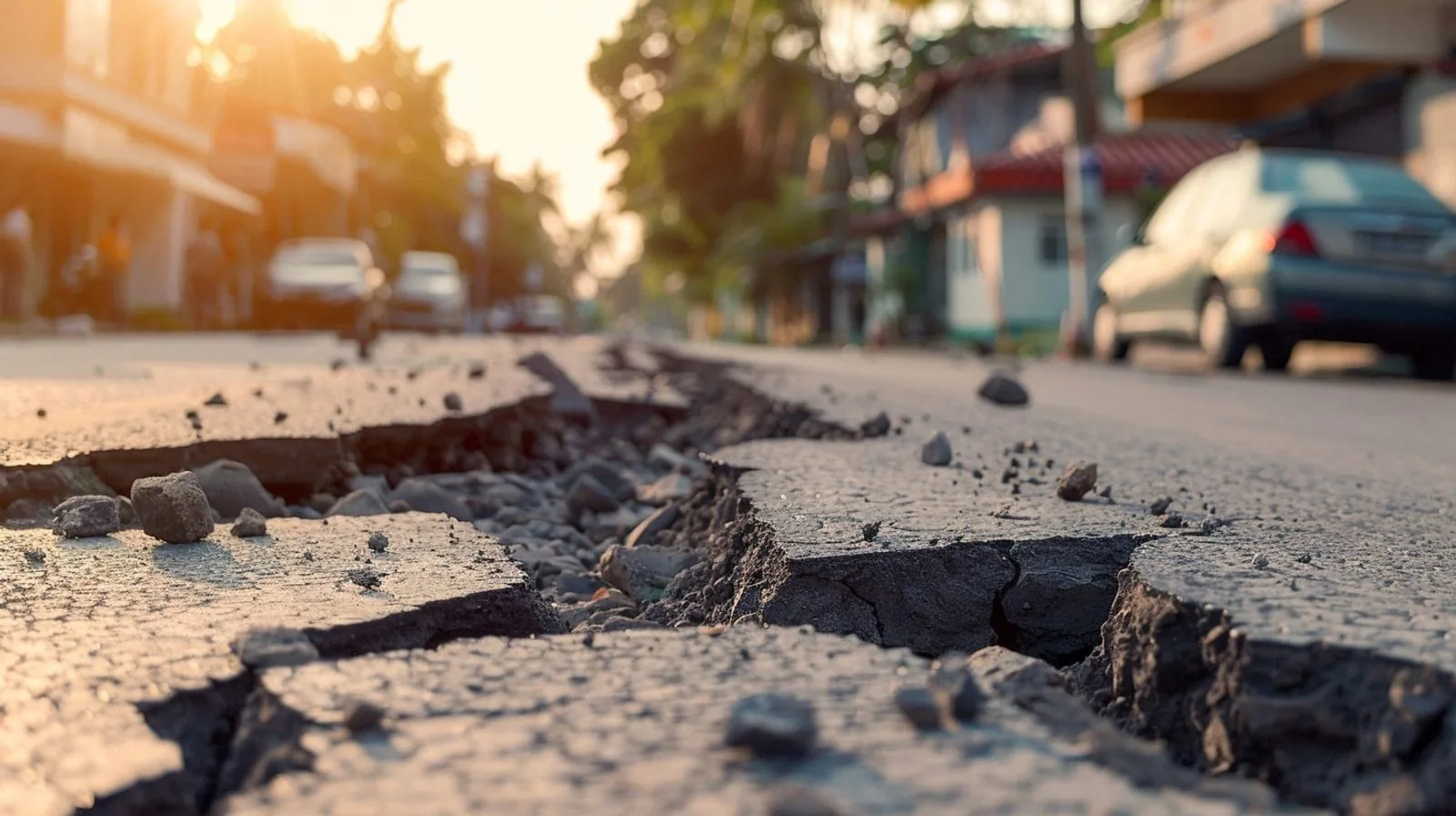
Quick Answer:Earthquakes happen when the slow movement of tectonic plates builds up stress in the rocks along faults — cracks in the crust — until the rocks suddenly slip. The stored energy is released as seismic waves, which shake the ground. Most earthquakes occur at plate boundaries, where plates collide, pull apart, or slide past each other; scientists can measure the hazard and help us prepare, but no one can yet predict exactly when the next big one will strike.
The tectonic plate puzzle
Earth's outermost shell isn't one solid piece — it's a mosaic of large slabs called tectonic plates that drift on the slowly churning rock beneath. The motion is slow: typically about 1 to 10 centimeters per year, roughly the rate your fingernails grow. Where plates meet — sliding past, colliding, or pulling apart — the crust bends, breaks, and occasionally snaps. (USGS)
Stress, friction, and the sudden slip
As plates move, their edges often stick together because of friction. The rock keeps bending — storing elastic energy the way a stretched rubber band does — until the stress finally exceeds the strength of the stuck area. Then the rocks slip suddenly, releasing the stored energy as seismic waves that radiate outward from the rupture point and shake the ground. (USGS)
The role of faults
Faults are the fractures in the crust where this slipping happens. Many are ancient and scar the landscape; some are invisible at the surface. A fault may creep slowly and quietly for years, or lock in place for centuries and then break in seconds. The largest earthquakes tend to strike long faults along plate boundaries, where slip can extend for hundreds of kilometers in a single event. (USGS)
Anatomy of an earthquake: waves and shaking
An earthquake starts at its focus — the point inside the Earth where the rupture begins. The point on the surface directly above it is the epicenter. Energy travels outward from the focus as seismic waves, and the wave types behave differently:
- P-waves (primary waves)are the fastest, arriving first — about 6 to 7 kilometers per second in the crust. They compress and stretch the rock in the direction they travel, a push-pull motion.
- S-waves (secondary waves)arrive second, moving rock side to side (shearing), at roughly half the speed of P-waves. They can't travel through liquids — one clue that Earth's outer core is liquid.
- Surface wavestravel along the ground. They are the slowest but often the most damaging, particularly the rolling Rayleigh waves.
Measuring earthquakes
The size of an earthquake is reported using magnitude. The original 1935 Richter scale has been largely replaced by the moment magnitude scale, which measures the energy released more accurately for large quakes. The scale is logarithmic: each whole-number increase represents roughly 32 times more energy released — so a magnitude 7 releases about a thousand times the energy of a magnitude 5. (Michigan Tech — UPSeis)
Can earthquakes be predicted?
Not yet. Scientists can't say that a specific earthquake will happen on a specific day. What they can do is estimate long-term probabilities — how likely a fault is to produce a major earthquake within the next few decades, based on its history and slip rate. Research continues on monitoring ground deformation, changes in groundwater, and foreshock patterns, but no reliable short-term prediction method exists. (USGS)
Living with earthquakes
We can't stop earthquakes, but we can reduce what they do to us. Modern building codes, retrofitting older structures, and securing heavy furniture all cut damage and injuries. For personal preparation, the basics are: know how to "Drop, Cover, and Hold On" during shaking, keep an emergency kit, and have a plan for afterward. (Ready.gov)
The bottom line
Earthquakes are the price of living on a planet whose crust is always in motion. Plates drift, faults lock and release, and seismic waves carry the news. Understanding the physics doesn't let us predict the next quake — but it does help us build for it and prepare for it.
Sources & further reading
- The Science of Earthquakes — U.S. Geological Survey
- What is an earthquake and what causes them to happen? — USGS
- What causes earthquakes? — UPSeis, Michigan Technological University
- Earthquakes — Ready.gov (FEMA)
That’s the mechanism. The wonder is still allowed.