Quick Answer:Soundproofing works by stopping sound energy from traveling between spaces. Sound travels as vibrations through air and through solid structures, so effective soundproofing combines four strategies: adding mass to block sound, decoupling structures so vibrations cannot pass across, absorbing sound energy in cavities, and sealing every gap where air — and therefore sound — can leak.
The science behind soundproofing
Sound reaches you in two ways: as airborne sound (speech, music, noise traveling through air) and as structure-borne sound (footsteps and vibration traveling through walls, floors, and joists). A wall stops some of both, but how much depends on its mass, stiffness, and construction. Every material has a sound transmission class (STC) rating that measures how much airborne sound it blocks — a standard single drywall wall might rate around STC 33, while a properly built double-wall assembly can reach STC 50 or more, which roughly halves the perceived loudness.
Explain That Stuff's soundproofing guideand theWikipedia article on soundproofingboth provide solid overviews of these principles.
Four strategies, one goal
Blocking: mass and barriers
The simplest way to stop sound is to put something heavy in its path. Mass reflects sound energy — this is why concrete walls and brick block noise better than thin drywall. Mass-loaded vinyl and dense boards add mass to existing walls without rebuilding them. Sound also diffracts around barriers, so a barrier must be complete — it only works if it extends past the source and receiver without gaps.
Decoupling: breaking the vibration path
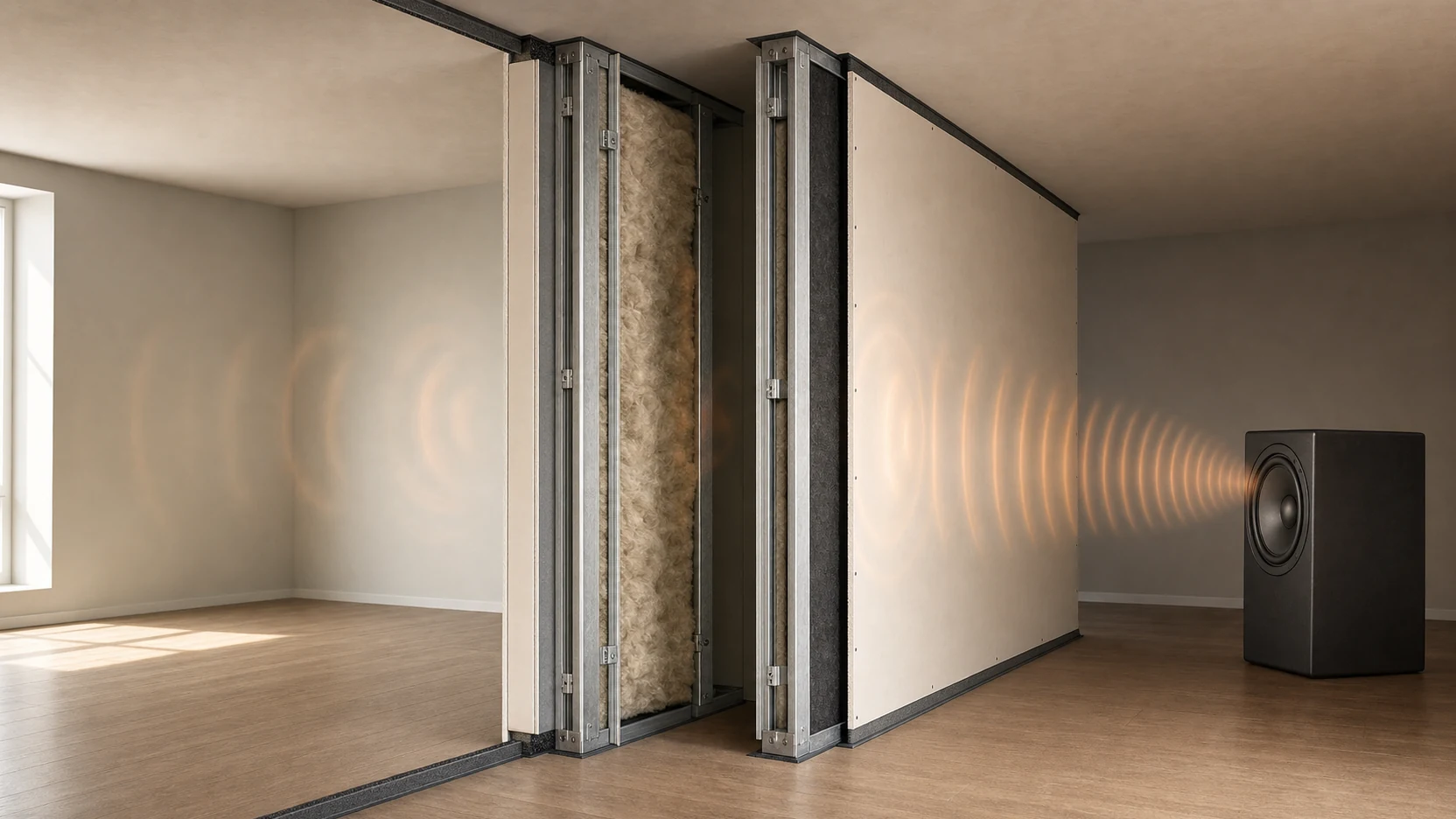
When a wall vibrates, it passes the vibration to whatever it touches. Decoupling means inserting a break in that chain: resilient channels, staggered studs, or double stud walls with a gap between them, so the two sides of the wall do not share a solid path. This is one of the most effective single upgrades for stopping structure-borne sound, and it is why "double walls" outperform a single thicker wall.
Absorbing: turning sound into heat
Inside a wall cavity, sound energy can be absorbed rather than transmitted. Porous materials such as fiberglass, mineral wool, and acoustic foam convert sound vibrations into tiny amounts of heat. Absorption also matters in rooms themselves: adding absorptive panels reduces echo and reverberation, which makes a room feel quieter even though it does not stop sound from leaving.
Sealing: killing the leaks
Every crack is a sound highway. A wall rated STC 50 with a 1% open gap performs far worse than its rating suggests. Sealing electrical outlets, light fixtures, pipe penetrations, and door perimeters with acoustic caulk and weatherstripping is often the cheapest large improvement available — and it is the step people most often skip.
Choosing materials
No single material does everything. Practical assemblies layer the four strategies: mass-loaded layers to block, resilient channels to decouple, mineral wool to absorb inside the cavity, and acoustic sealant around every penetration. TheMIT News explainerillustrates the same physics at the material level: even novel sound-suppressing fabrics work by exploiting resonance and vibration, the same mechanisms at play in a wall assembly.
Measuring success
Soundproofing results are measured, not guessed. STC ratings describe walls and floors; impact isolation class (IIC) describes how well a floor stops footsteps; and noise reduction (NR) measurements compare sound levels between rooms. A 10-decibel reduction is perceived as roughly halving loudness — so an improvement from STC 40 to STC 50 is dramatic, while a 3 dB change is barely noticeable.
The bottom line
Soundproofing is physics applied to building: mass reflects, decoupling interrupts, absorption consumes, and sealing completes. Effective rooms use all four — because sound, like water, finds every path you leave open.
Sources & further reading
That’s the mechanism. The wonder is still allowed.