

Quick Answer: When metals are heated, they expand, change strength properties, and undergo atomic-level transformations that alter their fundamental characteristics. These changes can be temporary (reversible upon cooling) or permanent, depending on temperature levels and exposure time, making heat a powerful tool for manipulating metal properties for specific applications.
The Immediate Impact of Heat on Metals
When that blowtorch or furnace first touches metal, an immediate dance of atoms begins. The most visible and immediate effect is thermal expansion, where metals grow larger as they heat up.
This expansion happens because of increased atomic vibrations within the metal’s structure. As heat energy transfers into the metal, atoms vibrate more vigorously, taking up more space. This causes the metal to expand in three ways:
- Length increases (linear expansion)
- Surface area grows (area expansion)
- Volume enlarges (volumetric expansion)
What’s fascinating is that different metals expand at different rates. Aluminum, for instance, expands about twice as much as steel for the same temperature increase. This varying expansion rate is critical knowledge for engineers and designers.
Consider bridges, which must withstand scorching summer heat and freezing winter cold. Engineers include expansion joints that allow the structure to grow and shrink with temperature changes without buckling or cracking. Similarly, railroad tracks include small gaps between sections to prevent buckling on hot days when the metal rails expand.
Uneven heating creates particular challenges. When one part of a metal piece heats faster than another, differential expansion occurs, potentially causing warping, bending, or internal stress that might compromise the metal’s integrity.
Changes in Strength and Ductility
As metals heat up, they undergo remarkable personality changes in terms of strength and flexibility.
Generally speaking, metals become weaker at higher temperatures. Their yield strength (the point at which they begin to deform permanently) and tensile strength (maximum stress they can withstand before breaking) both decrease. Think of it like ice cream on a hot day—what was once firm becomes increasingly soft and pliable.
However, this relationship isn’t always straightforward. Steel, for example, maintains most of its strength up to around 500°F (260°C), after which its strength decreases more dramatically. Each metal type has its own “temperature personality”:
- Aluminum alloys lose strength relatively quickly at elevated temperatures
- Titanium holds its strength better at higher temperatures
- Special “superalloys” like Inconel are designed specifically to maintain strength even at extremely high temperatures
While metals typically lose strength when heated, they simultaneously gain ductility—the ability to stretch or deform without breaking. This is why blacksmiths heat metal before shaping it; the increased ductility makes it easier to bend and form without cracking.

One particularly fascinating exception occurs under certain extreme conditions. Research from MIT has shown that under extremely high-speed impacts, some metals actually become stronger at elevated temperatures—a counter-intuitive finding that highlights the complex relationship between heat and metal properties.
The durability of these changes depends on exposure time and temperature:
- Instantaneous changes: Generally reversible once the metal cools
- Prolonged exposure: Can cause permanent metallurgical transformations that alter the metal’s properties even after cooling
Heat Treatment Processes
Humans have long harnessed the transformative power of heat to manipulate metals for specific purposes. Heat treatment involves carefully controlled heating and cooling cycles that alter a metal’s properties by changing its internal structure.
The main heat treatment processes include:
Annealing
Annealing involves heating metal to a specific temperature and then cooling it slowly. This process:
- Relieves internal stresses
- Increases ductility
- Reduces hardness
- Makes the metal more workable
Think of annealing like giving the metal a relaxing spa treatment—it emerges softer, more pliable, and with its internal tensions relieved.
Hardening
To harden metals (particularly steel), they’re heated to high temperatures and then rapidly cooled or “quenched” in water, oil, or air. This creates a harder but more brittle material. The rapid cooling traps carbon atoms in a specific crystalline structure that resists deformation—perfect for tools that need to maintain a sharp edge.
Tempering
Since hardened metals can be too brittle for many applications, tempering follows hardening. The metal is reheated to a lower temperature and then cooled, reducing brittleness while maintaining much of the hardness—finding that sweet spot between the two properties.
Other Specialized Treatments
Many other heat treatments exist for specific purposes:
- Normalizing: Similar to annealing but with air cooling instead of slow cooling
- Precipitation hardening: A multi-step process that creates tiny precipitates within the metal structure to block dislocations
- Case hardening: Creating a hard outer layer while keeping the core tough and ductile
Each of these processes follows precise time-temperature relationships to achieve the desired properties, making heat treatment both a science and an art.
Atomic and Phase Transformations
To truly understand how heat transforms metals, we need to zoom in to the atomic level, where the real magic happens.
Metals consist of atoms arranged in crystalline lattices—imagine a three-dimensional grid of atoms bonded together. When heat is applied, it doesn’t just make these atoms vibrate more; it can actually reorganize the entire structure.
Allotropic Transformations
Some metals undergo what’s called allotropic phase transformations when heated to specific temperatures. Iron, the primary component of steel, is a perfect example:
- At room temperature, iron atoms arrange in a body-centered cubic (BCC) structure
- When heated above 1,674°F (912°C), the structure changes to face-centered cubic (FCC)
- This FCC structure can dissolve more carbon, which is crucial for creating hardened steel
- At even higher temperatures, it reverts to another form of BCC structure
These transformations fundamentally change the metal’s properties, including hardness, strength, and magnetic behavior.

Phonon-Dislocation Interactions
At higher temperatures, heat generates vibrations in the crystal lattice called phonons. These phonons interact with dislocations (imperfections in the crystal structure) in fascinating ways.
Normally, dislocations allow metals to deform more easily. However, research has shown that under extreme conditions, phonons can actually interfere with dislocation movement through “phonon drag,” sometimes making the metal stronger at higher temperatures when subjected to very rapid deformation.
Diffusion Acceleration
Heat dramatically speeds up diffusion—the movement of atoms through the solid metal. This accelerated atomic movement enables:
- Homogenization of alloying elements
- Precipitation of strengthening particles
- Microstructural changes that alter mechanical properties
The rate of these transformations follows an exponential relationship with temperature, meaning that small temperature increases can dramatically accelerate these processes—explaining why precise temperature control is critical in metallurgy.
Practical Implications and Applications
Understanding how heat affects metals isn’t just theoretical—it has profound practical implications across numerous fields.
Designing for Thermal Expansion
Engineers must account for thermal expansion when designing everything from skyscrapers to microchips:
- Expansion joints in bridges and buildings
- Careful material selection for applications with temperature fluctuations
- Bimetallic strips in thermostats that bend when heated due to different expansion rates
Welding Considerations
Welding introduces intense, localized heat that creates complex metallurgical changes. Uneven heating during welding causes areas near the weld (the heat-affected zone) to experience different transformations than the surrounding material.

Welders must manage:
- Heat input control to minimize distortion
- Preheating to reduce thermal shock
- Post-weld heat treatment to relieve stresses
Manufacturing Applications
Heat’s transformative effects are harnessed across manufacturing processes:
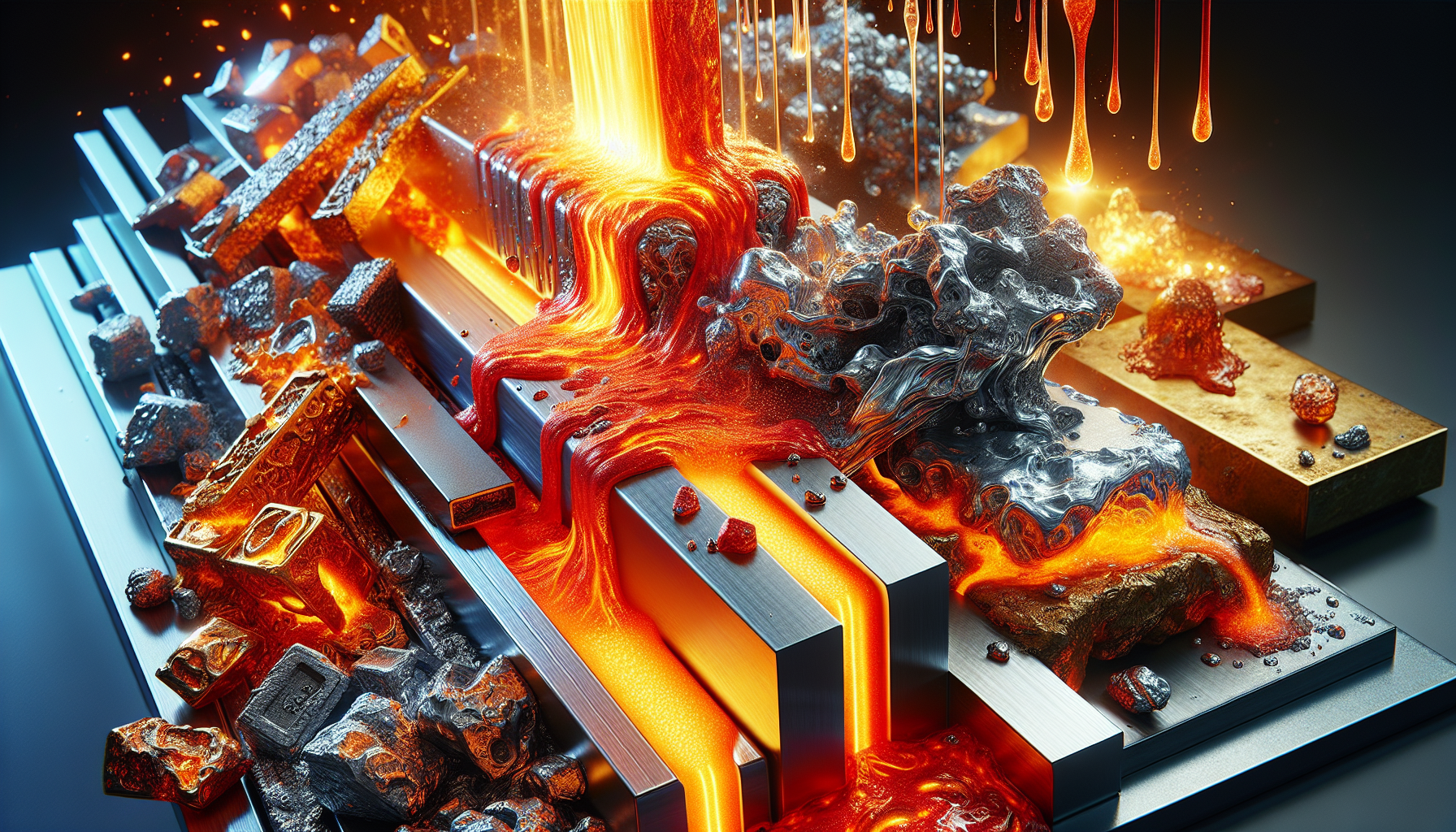
- Hot working: Shaping metals at high temperatures when they’re more ductile
- Casting: Pouring molten metal into molds and controlling cooling rates
- Additive manufacturing: Using heat sources like lasers to selectively melt metal powder in 3D printing
Safety Considerations
Heat’s effect on metal creates important safety implications:
- Structural steel in buildings loses strength during fires, requiring fire protection systems
- Pressure vessels and boilers need safety margins that account for high-temperature strength reduction
- Controlled cooling is essential to prevent brittleness in critical components
By understanding and respecting how heat transforms metals, engineers can design safer, more reliable systems that operate across temperature ranges.
Conclusion: The Heat-Metal Relationship
The relationship between heat and metal is a fascinating dance that humans have been choreographing for thousands of years. From the immediate physical expansion to the complex atomic rearrangements, heat’s transformative power gives us remarkable control over metal properties.
The next time you see a blacksmith at work, a welder joining metal, or even just a spoon expanding slightly in hot tea, you’re witnessing this ancient relationship in action—atoms responding to thermal energy in predictable yet remarkable ways.
Our mastery of these thermal transformations has built our modern world, from the tallest skyscrapers to the tiniest electronic components. By continuing to refine our understanding of how heat affects metals, we unlock new possibilities in engineering, manufacturing, and material science—pushing the boundaries of what’s possible with these versatile materials.