
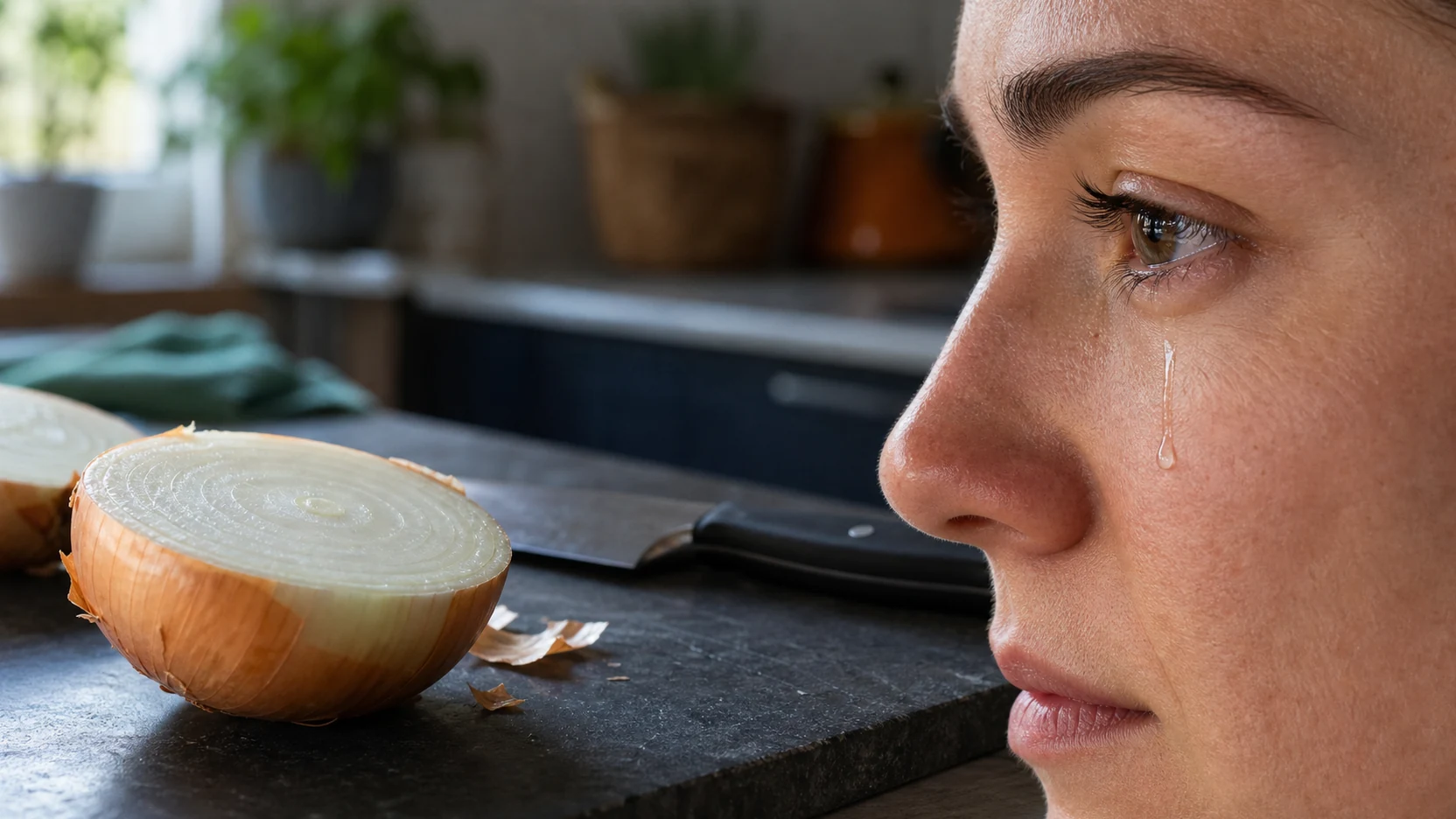
Quick Answer:Cutting an onion damages its cells and releases an enzyme that converts the onion's sulfur compounds into a volatile, eye-stinging gas called syn-propanethial-S-oxide. The gas reaches your eyes, reacts with their moisture to form a mild sulfuric acid, and your tear glands respond by producing reflex tears to wash the irritant away.
The tearful truth
Onions belong to theAlliumgenus — the same family as garlic, chives, and leeks — and they store sulfur absorbed from the soil inside their cells, partly as a defense against pests. An intact onion is harmless to your eyes because the chemicals that cause tearing are kept separate inside the cell. The trouble starts the moment a knife breaks the cells open and lets those chemicals mix.
The tears this produces are not emotional tears. They arereflex tears: your eyes' protective response to an irritant, washing it away rather than expressing a feeling.
The chemical chain reaction
The reaction that makes you cry was worked out only in 2002, when Japanese researchers identified the key enzyme —lachrymatory-factor synthase. Before that, scientists blamed a different enzyme (alliinase) that is actually only part of the story. The real sequence is:
- Cutting damages onion cells, releasing the enzyme lachrymatory-factor synthase and amino-acid sulfoxides.
- The enzyme converts the sulfoxides into an unstable intermediate, sulfenic acid.
- The sulfenic acid quickly rearranges into syn-propanethial-S-oxide — the volatile "lachrymatory factor."
- The gas diffuses through the air and reaches your eyes.
- On the moist surface of the eye it forms a dilute sulfuric-acid-like irritant, which stimulates nerve endings in the cornea.
- Your brain responds by ordering tear glands to produce reflex tears that flush the irritant away.
The whole sequence — from knife slice to streaming eyes — takes only seconds, which is why onion cutting can turn from kitchen routine into a weeping session so quickly.
Why some onions are worse than others
Not all onions are equally tear-inducing. The amount of sulfur in an onion's cells depends on the variety and the soil it grew in:
- Yellow and white onionsare typically high in sulfur compounds and produce strong reactions.
- Red onionsare usually similar to yellow varieties.
- Sweet onions(such as Vidalias) grow in low-sulfur soil, contain fewer tear-producing compounds, and cause fewer tears.
- Green onions and scallionscontain far less of the irritant.
Individual sensitivity varies too: some people have more sensitive eyes, and contact lenses can act as a partial barrier between the gas and the cornea. Repeated exposure does not build immunity.
Ways to tame the tears
Because the reaction needs the enzyme to meet the sulfur compounds, most kitchen strategies work by slowing the chemistry or keeping the gas away from your eyes:
- Chill the onion first.Cold slows enzyme activity — 30 minutes in the fridge reduces gas production.
- Use a sharp knife.A clean cut damages fewer cells than a crushing one, releasing less of the irritant.
- Cut near ventilation.A fan or open window carries the gas away from your face.
- Cut the root end last.The root holds the highest concentration of sulfur compounds.
- Wear goggles.A physical seal between the gas and your eyes works completely.
Folk remedies like burning a candle nearby or soaking bread in vinegar have no strong evidence behind them, though ventilation-based approaches — and the chemistry-based ones above — are reliably effective.
The bottom line
Onion tears are chemistry in action: a plant defense system that releases a volatile irritant when the onion's cells are damaged, and an equally elegant eye defense that washes the irritant away. The very sulfur compounds responsible for the sting are also what give onions much of their distinctive flavor — the "problem" and the taste come from the same molecules.
For further reading, theRoyal Society of Chemistry explains the lachrymatory chemistrybehind onion tears, including the enzyme responsible and how the reaction unfolds.
Sources & further reading
That’s the mechanism. The wonder is still allowed.