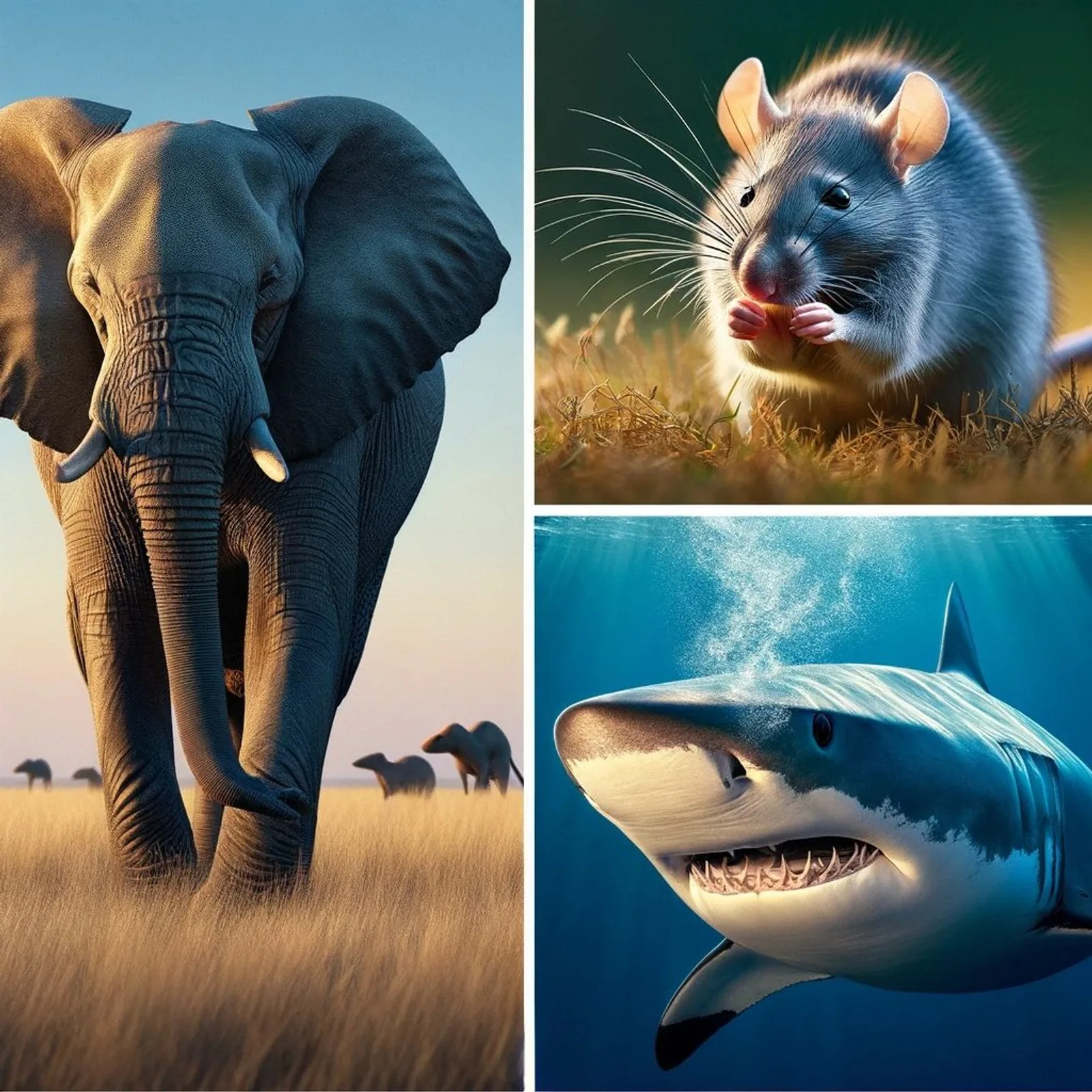
Quick Answer:Animals like the African elephant, rat, and shark have a very good sense of smell because scent is central to survival: it helps them locate food, identify mates, avoid predators, and navigate. These species have expanded olfactory machinery — more receptors, larger processing centers, and in some cases specialized anatomy — shaped by the demands of their environments.
The role of smell in animal behavior
Smell is one of the most fundamental senses for many animals, shaping behavior from the basic to the complex. Animals use scent to detect food sources from great distances — particularly important for scavengers and predators that must find food over large, sparsely populated areas. Scent also warns of danger: detecting the odor of predators or harmful substances triggers avoidance and flight responses, a key survival mechanism.
Communication through scent
Animals also communicate through olfactory signals. Pheromones — chemical signals released by animals — carry information about reproductive status, territorial boundaries, and individual identity. This chemical communication is essential for species that rely on social structures such as packs or colonies. (Semin et al., 2019)
The anatomy of smell
The olfactory system is the biological basis of a keen sense of smell. Animals with outstanding olfaction typically have a larger olfactory bulb — the brain region that processes smells — and more olfactory receptors: the proteins in the nose that bind odor molecules and send signals to the brain. (Sharma & Matsunami, 2014) The complexity varies widely across species: dogs, for example, have on the order of a few hundred million olfactory receptors, while humans have only a few million — along with a much smaller share of the brain devoted to processing scent. (Ache & Young, 2005)
Olfactory adaptations
Some animals have evolved specific adaptations that enhance an already strong sense of smell. Sharks devote a large share of their brain to olfaction and can detect certain dissolved compounds at extremely low concentrations. Elephants carry thousands of olfactory receptor genes — among the highest counts recorded for any mammal — consistent with their reliance on scent to find food and water across long distances. Bloodhounds combine vast receptor numbers with a long snout and loose, wrinkled skin that helps hold scent near the nose while they work a trail.
And not every famous nose is about smell: the star-nosed mole's star-shaped appendages are mostly touch organs, used to feel its way through mud and water.
Olfactory acuity and memory
The ability to detect and discriminate between odors is crucial for survival. Rats, known for their olfactory acuity, can follow scent trails while foraging. Memory reinforces smell, too: animals remember scents associated with specific outcomes, such as food rewards or dangerous encounters, which supports quick decisions in a complex world. (Colbert & Bargmann, 1997)
Sensory integration
A good sense of smell does not function in isolation. Animals integrate olfactory information with other sensory inputs, such as sight and hearing, to build a complete picture of their environment — a multisensory approach that improves their decisions.
When smell is impaired
The importance of smell stands out when it fades. In animals, losing the sense can disrupt finding food, avoiding predators, and social interaction. Researchers therefore study olfaction closely — as a window into how brains process chemical information, and because changes in smell can accompany a range of health conditions.
The bottom line
The exceptional sense of smell found in some animals is a testament to how sensory systems adapt to different ecological niches. Elephants, rats, sharks, and dogs each read the chemical world with equipment tuned to their survival needs — a reminder that every species experiences reality through its own senses.
Sources & further reading
- Ache, B., & Young, J. (2005). Olfaction: diverse species, conserved principles. Neuron, 48(3), 417–430.
- Cherry, J., & Baum, M. (2019). Sex differences in main olfactory system pathways involved in psychosexual function. Genes, Brain and Behavior, 19(2).
- Colbert, H., & Bargmann, C. (1997). Environmental signals modulate olfactory acuity, discrimination, and memory in Caenorhabditis elegans. Learning & Memory, 4(2), 179–191.
- Peng, Z., et al. (2022). Transcriptome analysis reveals olfactory system expression characteristics of aquatic snakes. Frontiers in Genetics, 13.
- Semin, G., et al. (2019). Inter- and intra-species communication of emotion: chemosignals as the neglected medium. Animals, 9(11), 887.
- Sharma, R., & Matsunami, H. (2014). Mechanisms of olfaction.
- Steiger, S., Fidler, A., & Kempenaers, B. (2009). Evidence for increased olfactory receptor gene repertoire size in two nocturnal bird species with well-developed olfactory ability. BMC Evolutionary Biology, 9, 117.
That’s the mechanism. The wonder is still allowed.