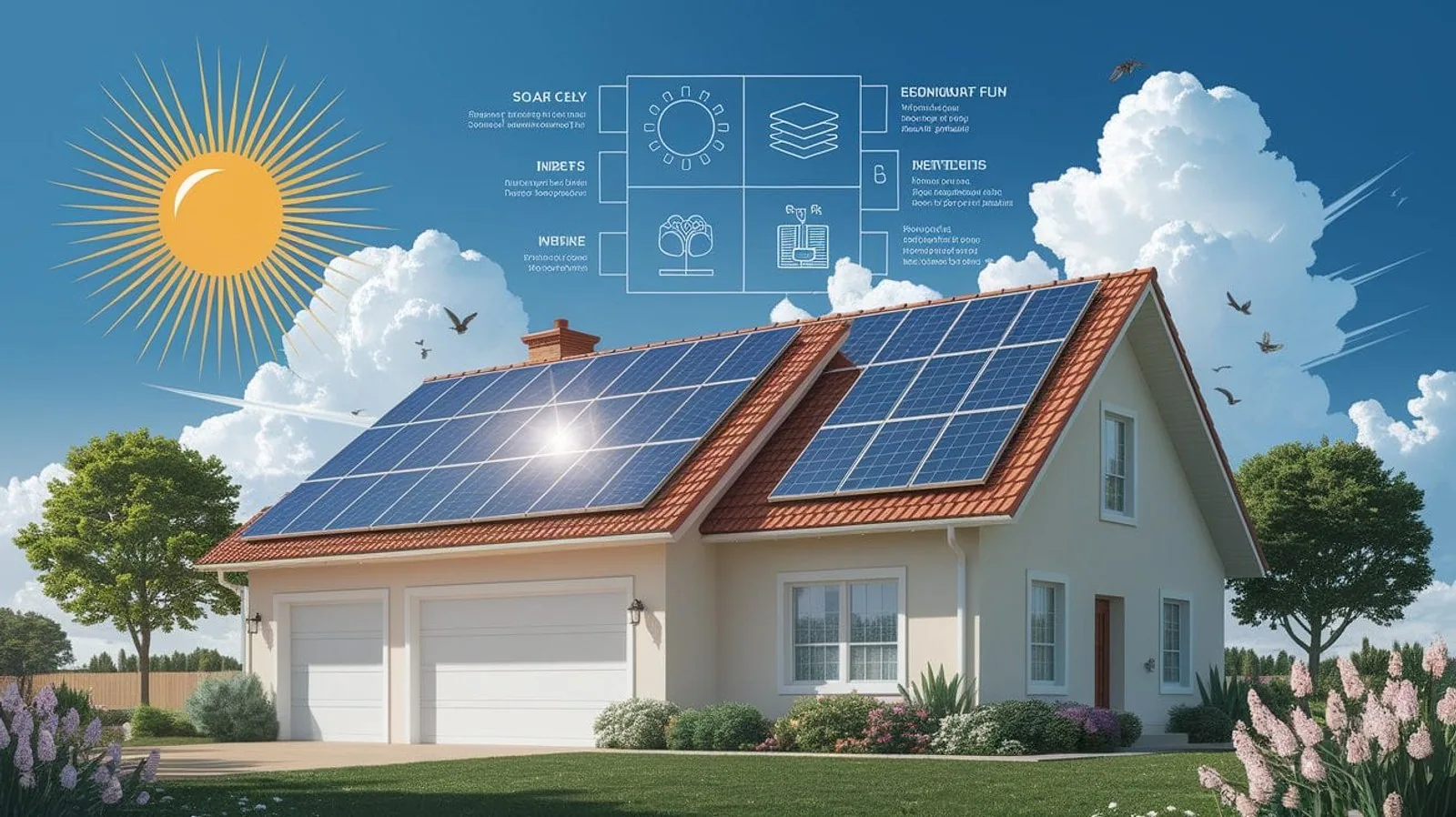
Quick Answer:Solar panels turn sunlight into electricity through the photovoltaic effect: photons of light knock electrons loose inside semiconductor layers, and the movement of those electrons creates an electric current. Panels produce direct current (DC), which an inverter converts into the alternating current (AC) homes and businesses use.
The photovoltaic effect in action
When sunlight hits a photovoltaic (PV) cell, each photon carries enough energy to free an electron from its atom inside the semiconductor — almost alwayssilicon. The cell is built so that freed electrons move in one direction, creating a flow of electrical current. Panels still produce electricity in cloudy or low light, but output is strongest in direct sunshine.
The basic physics is the same in every panel: light arrives, electrons are released, and an electric field channels them toward conductive pathways. That field comes from the cell's construction — layers of silicon treated with different elements so one side carries a slight negative charge and the other a slight positive one.
Anatomy of a solar panel
A solar panel is a sandwich of carefully chosen materials, each with a specific job:
- Photovoltaic cells.Silicon wafers treated with elements such as phosphorus and boron create the electric field that drives freed electrons toward the circuit.
- Protective glass.Shields the cells from weather while letting sunlight pass through.
- Anti-reflective coating.Reduces the sunlight that bounces off the surface so more of it reaches the cells.
- Metal conductive grid.Collects the moving electrons and channels them through bus bars to the junction box.
- Junction box and wiring.Connect the panel to the rest of the solar power system.
TheU.S. Energy Information Administrationprovides a detailed breakdown of how these components work together, andLive Science's explainercovers the underlying physics of the photovoltaic effect.
Types of solar panels
Different manufacturing approaches produce panels with different trade-offs:
- Monocrystalline panels.Cut from a single silicon crystal, they offer the highest efficiency and a uniform dark appearance, at a higher cost.
- Polycrystalline panels.Made from multiple silicon fragments melted together, they cost less and are slightly less efficient.
- Thin-film panels.Ultra-thin photovoltaic layers deposited on a substrate are lightweight and flexible, but typically less efficient than crystalline panels.
From cells to system: wiring and inverters
A single panel produces limited power, so installations group panels into an array. How they are wired changes the electrical output:
- Series wiring.Voltages from each panel add together while current stays the same — useful for reaching the higher voltages inverters need.
- Parallel wiring.Currents add while voltage stays the same — useful for increasing power while keeping voltage manageable.
Panels produce direct current, but grid-connected homes run on alternating current. Aninverterconverts DC to AC so the electricity can run ordinary appliances or feed back into the power grid — in many places throughnet metering, where surplus power earns credit on the household bill.
What affects solar efficiency
Real-world output depends on more than the panel's rated efficiency:
- Material quality.Higher-purity silicon performs better.
- Orientation and tilt.Panels aimed to track the sun's path through the day produce more.
- Temperature.Solar cells are semiconductors; surprisingly, cooler panels perform better than very hot ones.
- Shading and dust.Even partial shade on one cell can reduce a whole string's output, and a layer of dust costs measurable production.
The bottom line
Solar panels are direct converters of light into electricity: photons free electrons in a semiconductor, and the panel's structure turns that freed-electron flow into a usable current. The engineering around the cells — glass, coatings, wiring, and inverters — exists to maximize and harness that one fundamental effect.
Sources & further reading
That’s the mechanism. The wonder is still allowed.