


Quick Answer: Birds navigate during migration using an impressive array of tools including celestial cues (sun and stars), Earth’s magnetic field, genetic programming, and environmental landmarks. These navigation systems work together like a biological GPS, allowing birds to travel thousands of miles with remarkable precision, often returning to the exact same locations year after year.
Introduction – The Marvel of Avian Migration
Every year, billions of birds embark on epic journeys spanning continents and oceans. The Arctic Tern travels nearly 44,000 miles annually between the Arctic and Antarctic—the longest known migration of any animal. But how do these remarkable creatures find their way across such vast distances without maps or GPS?

This question has fascinated scientists for centuries. Modern research has revealed that birds possess a sophisticated navigation toolkit that puts our human sense of direction to shame. Their navigation abilities include:
- Reading the sun and stars like celestial compasses
- Sensing Earth’s magnetic field
- Following innate, genetically programmed directions
- Using visual landmarks and even scents
Let’s explore each of these fascinating mechanisms that allow birds to perform one of nature’s most impressive feats.
Celestial Navigation
Look up at the night sky. Can you navigate by the stars? Many birds can! Birds use celestial bodies as natural compasses to determine direction during migration.
The Sun Compass
During daylight hours, many birds use the sun’s position as a primary directional guide. But there’s a problem: the sun moves across the sky throughout the day. To compensate, birds possess an internal clock that helps them adjust for the sun’s changing position.
This remarkable ability allows birds to maintain a consistent heading regardless of the time of day. Studies have shown that birds can even compensate for the different rates of the sun’s movement across the sky depending on season and latitude.

Polarized Light Detection
Birds can see something humans cannot—patterns of polarized light in the sky. At sunset and sunrise, light from the sun creates distinctive polarization patterns that birds can detect and use for orientation, even when the sun itself isn’t visible. This ability proves especially valuable during dawn and dusk when many migratory species are most active.
According to research, these polarization patterns may be detected through special cryptochrome proteins linked to birds’ circadian clocks, providing them with a reliable compass when direct sun observation isn’t possible.
Star Navigation
Nocturnal migrants face the challenge of navigating in darkness. Their solution? Using the stars as a guide. Just as ancient human sailors used celestial navigation, many birds can orient themselves using star patterns.
Young birds learn to recognize key star patterns, particularly around the North Star (Polaris), which remains relatively fixed in the night sky. This star-based compass provides consistent directional information throughout the night, allowing birds to maintain their course even without daylight cues.
Magnetic Field Detection
Perhaps the most mysterious of birds’ navigation tools is their ability to detect Earth’s magnetic field—a sense called magnetoreception.
The Biological Compass
Birds possess specialized cells containing magnetite (a naturally magnetic mineral) or photoreceptive proteins that can detect the Earth’s magnetic field. This biological compass provides birds with information about:
- Direction – like a compass needle pointing north
- Inclination – the angle of magnetic field lines relative to Earth’s surface
- Intensity – the strength of the magnetic field, which varies by location
Recent magnetic displacement experiments with Eurasian reed warblers have shown that birds rely particularly on inclination (angle to horizontal) and declination (angle from true north) for positional information—challenging prior theories that birds need all magnetic components to navigate.

Magnetic Disruptions
This magnetic sense is so crucial that when it’s disrupted, migration can go awry. Research has found that geomagnetic disturbances from space weather can significantly disrupt nocturnal migration, reducing bird numbers in flight and increasing wind drift, especially under cloudy conditions when birds can’t access celestial cues.
These findings highlight how birds integrate multiple navigation systems, switching between them as environmental conditions change.
Genetic and Innate Orientation
One of the most fascinating aspects of bird migration is that many young birds can navigate to wintering grounds they’ve never visited before—without guidance from adults. How is this possible?
Programmed Directions
First-time migrant birds possess an innate orientation system that’s genetically programmed. Specific genes like MARB-a and InvP-Ch1 have been identified as determining migration direction through complex polygenic mechanisms.
This genetic programming follows what scientists call the “clock-and-compass” concept—young birds instinctively fly in a specific direction for a genetically determined amount of time, eventually arriving at their species’ traditional wintering grounds.

Inherited Migration Patterns
The genetic basis of migration is further demonstrated in hybrid birds, which often inherit migration patterns from their parents. Some hybrids follow intermediate routes between those typically taken by each parent species, showing how these behaviors are genetically encoded.
A remarkable example is the juvenile Eleonora’s falcon, which follows complex innate routes across barriers like the Mozambique Channel to reach Madagascar—a journey they’ve never made before but are programmed to complete.
Nocturnal Navigation and Behavioral Adaptations
Many birds migrate at night, which presents unique challenges and adaptations for successful navigation.
Night Flight Advantages
Nocturnal migration offers several advantages:
- Cooler temperatures reduce the risk of overheating during strenuous flight
- Calmer air conditions provide more stable flight conditions
- Reduced predator risk from diurnal birds of prey
- Clear view of stars for celestial navigation
Night migrants have developed specialized adaptations for navigating in darkness, including enhanced night vision and the ability to use star patterns for orientation.
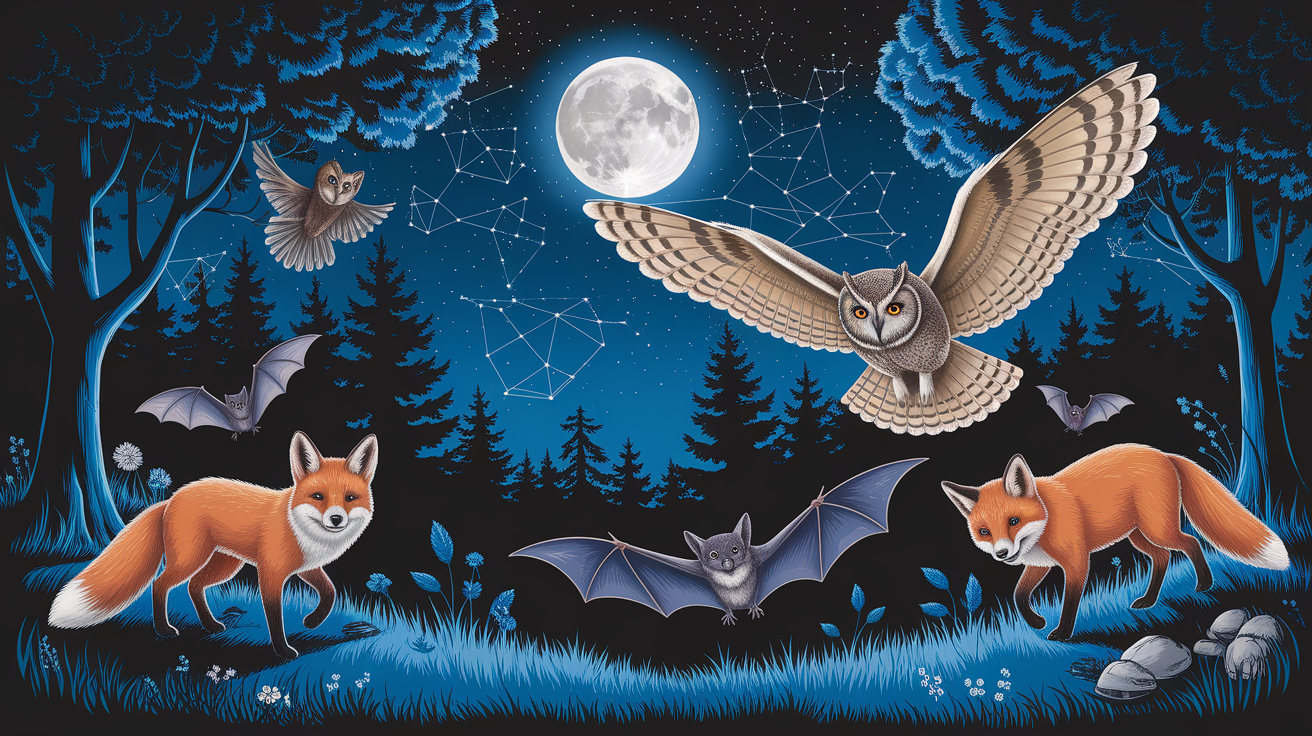
Migratory Restlessness
Birds experience a phenomenon known as “Zugunruhe” or migratory restlessness—a state of increased activity that coincides with migration seasons. This behavior is triggered by changing photoperiod (day length), which activates hormonal changes that prepare birds for migration.
Scientists have observed this behavior in captive birds using Emlen funnels, which show birds orienting in the direction they would normally migrate, even when kept indoors. This demonstrates the power of their internal calendar and compass.
Weather and Environmental Adaptations
Birds don’t fly blindly according to their genetic programming—they show remarkable behavioral plasticity in response to environmental conditions:
- Adjusting departure times based on weather conditions
- Altering flight altitudes to find favorable winds
- Using geographic features like coastlines and mountain ranges as visual guides
- Temporarily pausing migration during severe weather
This flexibility allows birds to optimize their journeys, saving energy and increasing survival chances during these demanding journeys.
Conclusion – The Symphony of Migration
Bird migration navigation isn’t dependent on a single mechanism but rather a symphony of complementary systems working together. This redundancy ensures that when one navigation tool becomes unavailable—like stars obscured by clouds—birds can switch to another, such as magnetic field detection.
What makes bird migration truly remarkable is how these various systems are integrated. Birds calibrate their magnetic compass against celestial cues, verify their position using familiar landmarks, and rely on genetic programming for overall direction—all while making real-time adjustments based on weather and geography.
The next time you see a V-formation of geese overhead or spot a tiny warbler that will soon journey thousands of miles, remember the extraordinary navigation capabilities packed into that small body—a natural wonder that continues to inspire both scientific research and human admiration.