


Quick Answer: Smell and taste are intricate chemical senses that work together to help us experience flavors, detect dangers, and create memories. While taste buds identify five basic qualities (sweet, sour, salty, bitter, and umami), our sense of smell provides about 80% of what we perceive as flavor through a remarkable system of specialized neurons that can detect thousands of different odor molecules.
The Intricate Dance of Smell and Taste
Ever wondered why food seems tasteless when you have a stuffy nose? That’s because smell and taste perform an elaborate dance together, creating what we recognize as flavor. These two chemical sensing systems are deeply interconnected, working in harmony to create our rich sensory experiences with food and our environment.

Our ability to detect odors and tastes serves several crucial purposes:
- Helping us identify nutritious foods
- Warning us of potential dangers like spoiled food or environmental hazards
- Creating powerful emotional connections and memories
- Enhancing our overall quality of life through sensory pleasure
While most people think of taste as the star of the show when enjoying food, it’s actually our sense of smell doing most of the heavy lifting. Let’s dive into the fascinating science behind these interconnected senses.
The Olfactory System: A Closer Look
Our sense of smell begins in a specialized patch of tissue high inside the nose called the olfactory epithelium. This remarkable tissue houses millions of specialized cells and structures working together to detect odors.
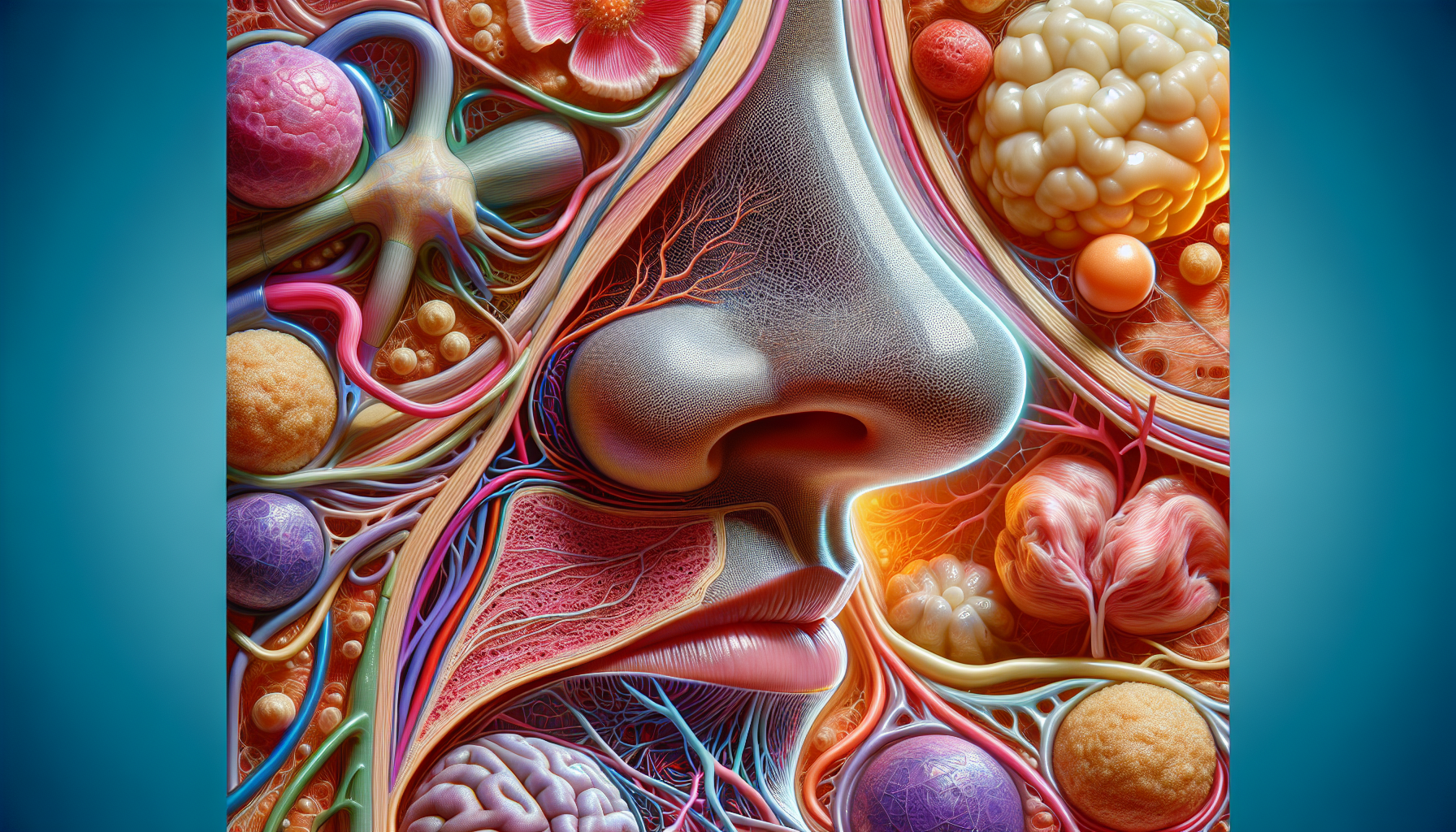
The key components of this system include:
- Olfactory receptor neurons (ORNs) – These bipolar neurons are the actual detectors that bind to odor molecules
- Sustentacular cells – Supporting cells that help maintain the health of the epithelium
- Basal cells – Stem-like cells that generate new receptor neurons
- Microvillar cells – Additional support cells in the epithelium
- Mucus layer – A protective coating where odor molecules dissolve before detection
What makes our olfactory system truly remarkable is its organization. Each olfactory neuron follows the “one neuron, one receptor” rule, meaning it expresses only one type of odor receptor. With approximately 400 different receptor types in humans, this arrangement allows for a combinatorial detection system that can distinguish thousands of different odors.
The Pathway of Smell
How exactly does a scent molecule in the air become a perceived smell in our mind? The journey is nothing short of extraordinary.
Step 1: Odor Detection
When we inhale, odor molecules enter our nasal cavity and dissolve in the mucus covering the olfactory epithelium. These molecules bind to specific receptor proteins on the cilia (tiny hair-like projections) of the olfactory receptor neurons.
Step 2: Signal Transduction
When an odor binds to a receptor, it activates a cascade of molecular events:
- The receptor activates a G-protein called Gαolf
- This triggers adenylyl cyclase III to produce cAMP (cyclic adenosine monophosphate)
- cAMP opens ion channels, allowing positively charged ions to flow into the neuron
- This creates an electrical signal (action potential) that travels along the neuron’s axon
This process, called olfactory transduction, is how chemical information from odors gets converted into electrical signals our brain can process.

Step 3: Signal Transmission
The axons of olfactory neurons bundle together to form the olfactory nerve (cranial nerve I), which passes through a bony structure called the cribriform plate to reach the brain. These nerves connect to specialized structures in the olfactory bulb called glomeruli.
Step 4: Signal Processing
In the olfactory bulb, signals are refined and processed by several types of neurons:
- Mitral cells and tufted cells – Receive signals from the olfactory neurons
- Periglomerular cells – Inhibitory interneurons that help refine the signal
- Granule cells – Another type of inhibitory neuron for signal refinement
From here, processed signals travel through the olfactory tract to several brain regions, including the piriform cortex, entorhinal cortex, olfactory tubercle, and the anterior olfactory nucleus – collectively known as the primary olfactory cortex.
Step 5: Perception and Integration
Unlike other sensory systems, olfactory information bypasses the thalamus and goes directly to cortical areas and the limbic system, which explains the powerful emotional and memory connections associated with smells. The information ultimately reaches the orbitofrontal cortex for conscious perception of odors.
The Science Behind Taste
While smell involves hundreds of receptors detecting countless combinations of odors, taste is somewhat simpler but no less fascinating.
The Five Basic Tastes
Our taste system is designed to detect five primary taste qualities:
- Sweet – Signals carbohydrates and energy-rich foods
- Sour – Indicates acidity, potentially unripe or spoiled foods
- Salty – Detects essential minerals
- Bitter – Often warns of potential toxins
- Umami – Signals protein-rich foods (often described as “savory” or “meaty”)
Taste Buds and Papillae
Taste detection happens in specialized structures called taste buds, which are housed within protrusions on the tongue called papillae. Each taste bud contains 50-100 taste receptor cells that detect specific taste molecules.

When taste molecules dissolve in saliva and bind to receptors on these cells, they trigger signals that travel through three different cranial nerves:
- Facial nerve (VII) – front of the tongue
- Glossopharyngeal nerve (IX) – back of the tongue
- Vagus nerve (X) – throat area
These signals then travel to the brain’s gustatory centers for processing and perception.
The Interplay of Smell and Taste in Flavor Perception
Here’s a surprising fact: approximately 80% of what we perceive as “taste” actually comes from our sense of smell! This occurs through a process called retronasal olfaction.
Orthonasal vs. Retronasal Olfaction
There are two ways odors reach our olfactory epithelium:
- Orthonasal olfaction – Sniffing odors through the nose (what we typically think of as “smelling”)
- Retronasal olfaction – When odors from food in our mouth travel up the back of the throat to the nasal cavity
When we eat, volatile compounds are released from food in our mouths. As we chew and swallow, these compounds travel up to our olfactory epithelium, creating what we perceive as flavor.

The Flavor Symphony
What we call “flavor” is actually a complex integration of multiple sensory inputs:
- Taste (sweet, sour, salty, bitter, umami)
- Smell (thousands of different odor compounds)
- Texture (detected by mechanoreceptors)
- Temperature
- Spiciness/irritation (detected by pain receptors)
This is why a head cold dramatically reduces our ability to “taste” food – we’re actually losing most of our smell function, which provides the majority of flavor perception.
The brain areas processing taste and smell are closely connected, particularly in regions linked to emotion and memory. This explains why certain flavors can trigger powerful nostalgic memories or why comfort foods can improve our mood.
The Resilience and Vulnerability of the Olfactory System
Our olfactory system has an extraordinary capability that sets it apart from most other neural systems: it can regenerate throughout our lifetime.
Remarkable Regeneration
Olfactory receptor neurons have a limited lifespan of about 30-60 days due to their constant exposure to environmental stressors. Fortunately, the olfactory system has built-in renewal capabilities:
- Basal cells in the olfactory epithelium act as stem cells, continuously generating new receptor neurons
- These new neurons extend axons through the cribriform plate to reconnect with the olfactory bulb
- This remarkable process allows for lifelong smell function even as individual cells are regularly replaced
Vulnerabilities and Disorders
Despite its regenerative abilities, our sense of smell is vulnerable to disruption:
- Viral infections – Certain viruses (including coronaviruses) can damage olfactory neurons or supporting cells
- Head trauma – Can damage the delicate nerves as they pass through the cribriform plate
- Aging – Olfactory function typically declines with age
- Neurodegenerative diseases – Conditions like Parkinson’s often feature early loss of smell
- Genetic conditions – Some disorders affect the cilia of olfactory neurons, causing anosmia (loss of smell)
Loss of smell and taste can significantly impact quality of life, affecting everything from food enjoyment to safety (detecting smoke or gas leaks) and social interactions.
Conclusion: The Symphony of Smell and Taste
Our chemical senses of smell and taste represent some of nature’s most elegant designs. From the remarkable “one neuron, one receptor” organization that allows us to detect countless odors with just 400 receptor types, to the integrated flavor perception system that combines multiple sensory inputs, these senses are marvels of efficiency and complexity.
The next time you savor a delicious meal or stop to smell the roses, take a moment to appreciate the extraordinary neural processes making those experiences possible. And remember – when it comes to flavor perception, your nose deserves most of the credit!